
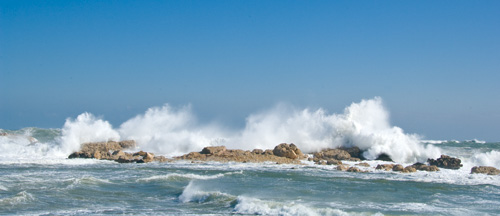
MARE
They invade the beaches in flocks, wearing yellow helmets and green waders; they spend the afternoon rummaging through the mud with childlike joy. They also have a special name for the mud: sediment. Depending on the mud’s qualities, such as grain size and porosity, they can spend whole evenings rather happily classifying the mud: sandy mud, silty mud, clay mud, muddy mud…their friends usually think that this is highly amusing. Those invaders, whose main interest is not the grain size but all that lives and thrives near, on and in between grains, are also known as marine biologists. Even on a scaldingly hot day when beaches seem to be deserted apart from tourists, they still find a multitude of organisms hidden in the Mediterranean mud. Apart from diatoms (unicellular algae with silica shells), gastrotrichs (tiny and short-lived animals with, literally, hairy bellies) and tardigrads are much beloved by many marine biologists. Both of these organisms are small enough to find a home in the tiny holes naturally occurring between sand particles, and they are also quite hardy. Especially tardigrads, which are also called water bears or moss piglets: they can withstand a century without water and endure temperatures ranging from -200°C to 100°C – that is about -328 to 212 F. Some marine scientists, however, are more interested in where the sediment has come from and why, and would like to know more about the water surrounding the sand particles. These are sometimes known as oceanographers. Oceanographers and marine chemists alike can often be found having a great time burning sediment cores in order to gain more detailed information on the history of the seas. Regards to the Mediterranean Sea, history is a story of complicatedness. In a nutshell, it is a story of change: sea levels of the Mediterranean Sea have fallen and risen periodically as ice ages came and went. There is some evidence that, throughout the last ice age, parts of it might have fallen completely dry, leaving nothing but a few unconnected salt lakes behind. This is why some ancient cave paintings now lie hidden beneath up to 30m of water. The Mediterranean Sea’s salinity and temperature have also gone through changes. These days, the water is rather warm and salty and can therefore be tracked as a clearly defined body of water, even as it flows out of the Mediterranean basin and into the Atlantic Ocean. At 1km depth, Mediterranean water can still be told apart from Atlantic water. However, this has been different in the past. There have been times, when there was more rain and more fresh water input from rivers, both contributing to the cooling of the seawater, which then also became less salty. Buried deep in the sediments, there are the remainders of formanifers, tiny unicellular organisms whose chambered shells are silent witnesses of times gone by as their shell composition changes relative to changes in their environment. The future of the Mediterranean Sea is not easy to predict at all, but does not look too good in times of global warming, overfishing and increasing pollution. We can rest assured, though, that the tardigrades at least are going to stick around for many years to come.