


Page 24 - Costa Live - Magazine
P. 24
FR
DE
„Meitat de França, meitat d‘Espanya, no hi ha altra terra com la Cerdanya „ – these are
the first lines of the hymn of Cerdanya – Cerdagne, in French – and they perfectly apply to
the winter sports village of Llívia.
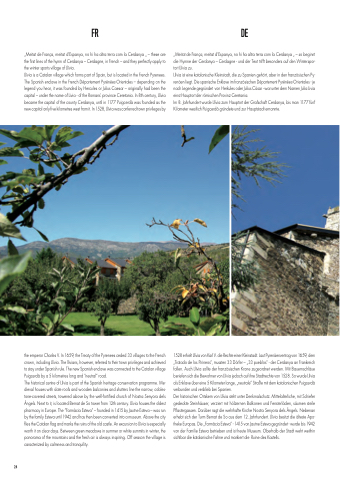
Llívia is a Catalan village which forms part of Spain, but is located in the French Pyrenees.
The Spanish enclave in the French Département Pyrénées-Orientales – depending on the
legend you hear, it was founded by Hercules or Julius Caesar – originally had been the
capital – under the name of Livia - of the Romans’ province Ceretania. In 8th century, Llívia
became the capital of the county Cerdanya, until in 1177 Puigcerdà was founded as the
new capital only five kilometres west from it. In 1528, Llívia was conferred town privileges by
„Meitat de França, meitat d‘Espanya, no hi ha altra terra com la Cerdanya „ – so beginnt
die Hymne der Cerdanya – Cerdagne - und der Text trifft besonders auf den Winterspor-
tort Llívia zu.
Llívia ist eine katalanische Kleinstadt, die zu Spanien gehört, aber in den französischen Py-
renäen liegt. Die spanische Enklave im französischen Département Pyrénées-Orientales - je
nach Legende gegründet von Herkules oder Julius Cäsar - war unter dem Namen Julia Livia
einst Hauptort der römischen Provinz Ceretania.
Im 8. Jahrhundert wurde Llívia zum Hauptort der Grafschaft Cerdanya, bis man 1177 fünf
Kilometer westlich Puigcerdà gründete und zur Hauptstadt ernannte.
the emperor Charles V. In 1659, the Treaty of the Pyrenees ceded 33 villages to the French
crown, including Llívia. The llivians, however, referred to their town privileges and achieved
to stay under Spanish rule. The new Spanish enclave was connected to the Catalan village
Puigcerdà by a 5 kilometres long and “neutral“ road.
The historical centre of Llívia is part of the Spanish heritage conservation programme. Me-
dieval houses with slate roofs and wooden balconies and shutters line the narrow, cobles-
tone-covered streets, towered above by the well-fortified church of Nostra Senyora dels
Àngels. Next to it, is located Bernat de So tower from 12th century. Llívia houses the oldest
pharmacy in Europe. The “Farmàcia Esteva“ – founded in 1415 by Jautne Esteva – was run
by the family Esteva until 1942 and has then been converted into a museum. Above the city
flies the Catalan flag and marks the ruins of the old castle. An excursion to Llívia is especially
worth it on clear days. Between green meadows in summer or white summits in winter, the
panorama of the mountains and the fresh air is always inspiring. Off season the village is
caracterized by calmness and tranquility.
1528 erhielt Llívia von Karl V. die Rechte einer Kleinstadt. Laut Pyrenäenvertrag von 1659, dem
„Tratado de los Pirineos“, mussten 33 Dörfer – „33 pueblos“ - der Cerdanya an Frankreich
fallen. Auch Llívia sollte der französischen Krone zugeordnet werden. Mit Bauernschläue
beriefen sich die Bewohner von Llívia jedoch auf ihre Stadtrechte von 1528. So wurde Llívia
als Enklave über eine 5 Kilometer lange, „neutrale“ Straße mit dem katalanischen Puigcerdà
verbunden und verblieb bei Spanien.
Der historischen Ortskern von Llívia steht unter Denkmalschutz. Mittelalterliche, mit Schiefer
gedeckte Steinhäuser, verziert mit hölzernen Balkonen und Fensterläden, säumen steile
Pflastergassen. Darüber ragt die wehrhafte Kirche Nostra Senyora dels Àngels. Nebenan
erhebt sich der Turm Bernat de So aus dem 12. Jahrhundert. Llívia besitzt die älteste Apo-
theke Europas. Die „Farmàcia Esteva“ - 1415 von Jautne Esteva gegründet - wurde bis 1942
von der Familie Esteva betrieben und ist heute Museum. Oberhalb der Stadt weht weithin
sichtbar die katalanische Fahne und markiert die Ruine des Kastells.
24


